Managed Print Services for Downtown Miami Offices — Streamline Costs, Security and Workflow
Managed Print Services (MPS) take the guesswork out of buying, monitoring and maintaining printers and multifunction devices so Downtown Miami offices can cut costs, protect sensitive documents and keep people moving. By centralizing fleet management and using print data to guide decisions, MPS reduces wasteful printing, lowers cost‑per‑page and plugs into IT and cybersecurity controls to safeguard information. This guide explains why Miami firms choose MPS, how fleet management boosts efficiency, what local MPS packages include, and leasing and sustainability options tailored to South Florida workplaces.
You’ll find concrete cost‑saving tactics, security features like secure print release, best practices for device consolidation, and examples of automated supplies and workflow automation that speed document handling. Throughout, we highlight how local expertise and integrated services match Miami office needs while keeping provider mentions practical and to the point. Keywords such as Managed Print Services Miami, printer fleet management Miami, print optimization Downtown, and secure printing solutions Miami are woven in to help readers connect solutions with outcomes.
Why Downtown Miami Offices Choose Managed Print Services
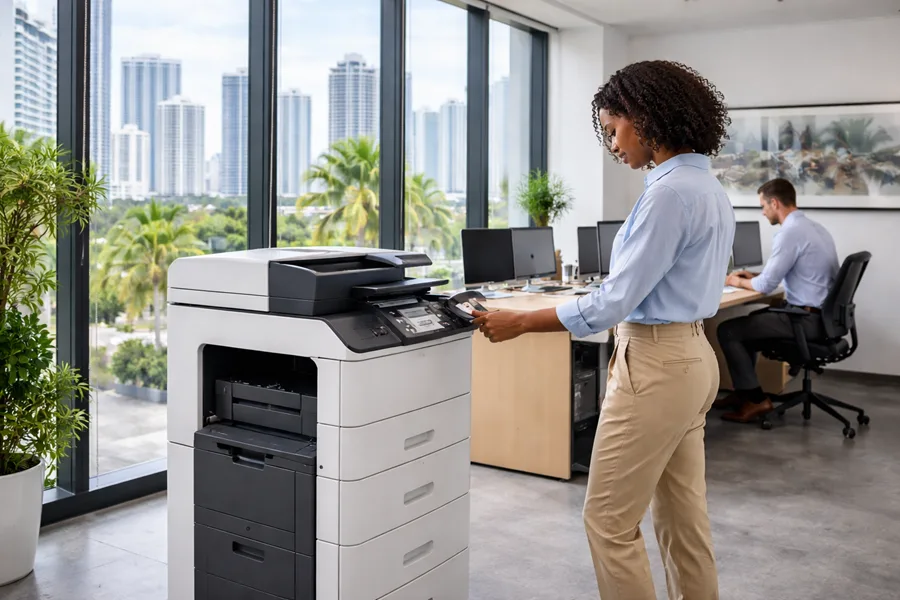
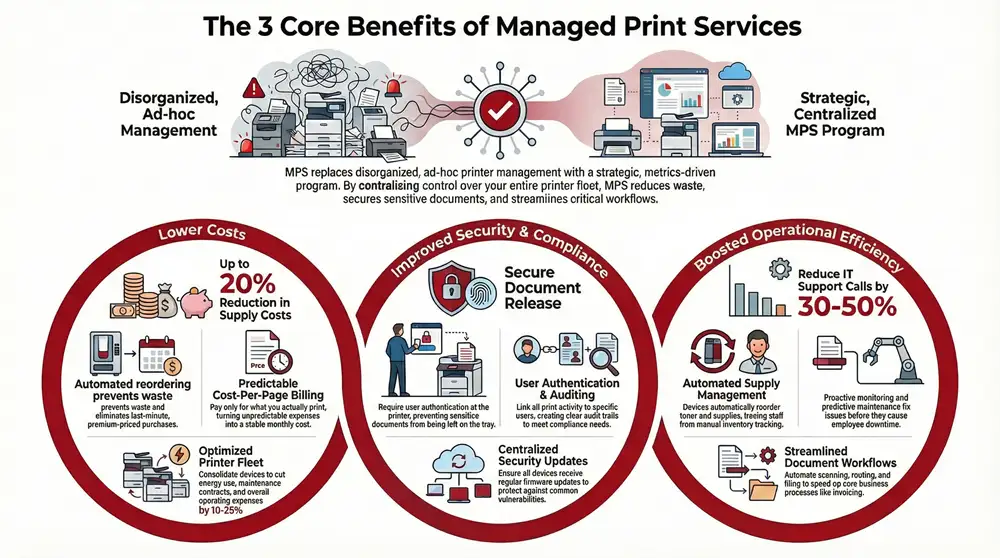
MPS replaces ad‑hoc purchases and break‑fix repairs with a managed, metrics‑driven program that lowers total printing costs, tightens document security and boosts productivity. The approach combines a continuous fleet assessment, clear usage policies, automated supplies reordering and proactive maintenance so offices pay less per page and face fewer surprise outages. The result: measurable savings on supplies and IT support, stronger compliance and smoother, more predictable print workflows for administrative teams. Those gains matter in Downtown Miami, where dense office layouts and high document volumes can magnify inefficiencies and security exposure.
MPS delivers three core benefits for Downtown Miami offices:
- Lower costs through device right‑sizing, cost‑per‑page billing and automated supplies management.
- Improved security and compliance with authentication, secure print release, encryption and auditing.
- Better operational efficiency via centralized monitoring, predictive maintenance and workflow automation.
The table below shows typical improvements organizations see when they move from unmanaged printing to an MPS program and helps prioritize which levers to pull first.
These quantified outcomes explain why teams moving to MPS free up budget and staff time for higher‑value work. Next, we break down the mechanisms — like cost‑per‑page models and consolidation — that deliver those savings.
How MPS Lowers Your Printing Costs
MPS aligns billing, supplies and device counts with real usage so you stop paying for waste and lower total cost of ownership. Cost‑per‑page agreements turn unpredictable cartridge buys into predictable operating expenses and encourage efficient device use. Automated supplies management avoids rushed, premium shipments. Right‑sizing and consolidation remove rarely used machines, cutting maintenance, energy and consumable costs. Commonly a single multifunction device replaces several underused desktops, reducing SKU variety and simplifying procurement.
- Cost‑per‑page billing: links cost to actual pages printed instead of surprise cartridge purchases.
- Automated reordering: avoids expedited shipping fees and reduces downtime.
- Device consolidation: lowers maintenance and energy costs while simplifying support.
Knowing these mechanisms helps finance and operations leaders forecast ROI and set realistic targets for a Downtown Miami office print program.
Security Benefits MPS Brings to Miami Businesses
MPS strengthens document security with secure print release, user authentication and encryption for data in transit and at rest — reducing the chance of sensitive documents being left on a tray. Secure release requires user authentication before a job prints; device‑level authentication links actions to audit trails for compliance. Regular firmware updates and centralized logging close common vulnerabilities and provide searchable records for audits. Together, these controls reduce risks like uncollected prints, unauthorised access and unnoticed data leaks.
- Secure document release: prevents unattended prints and accidental exposure.
- Authentication & role controls: limits printing capabilities by user or group.
- Encryption & audit logging: protects data and produces compliance evidence.
These protections integrate naturally with managed cybersecurity and IT services, creating a unified defense for document workflows and shortening incident response.
How Printer Fleet Management Improves Office Efficiency in Downtown Miami
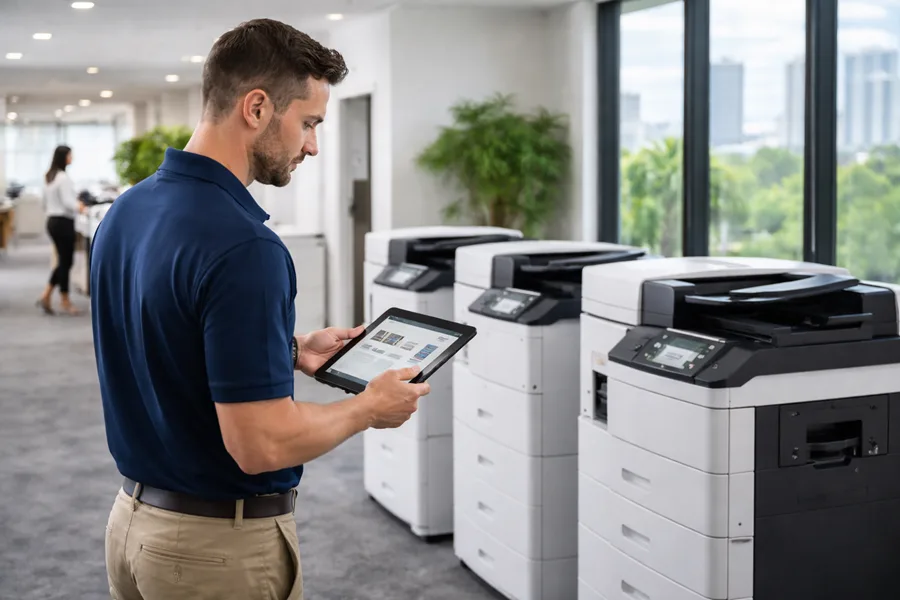
Fleet management centralizes monitoring and maintenance so issues are fixed before they slow people down, increasing uptime and cutting emergency service calls. Remote diagnostics and predictive maintenance flag failing parts and let techs schedule repairs during low‑impact windows, reducing user downtime. Centralized analytics reveal print volumes and device costs, helping managers make data‑driven consolidation and placement decisions across the floor plan. In Downtown Miami—where space is tight and operations are fast—these efficiencies translate into smoother admin processes and lower hidden costs.
Key operational levers fleet management uses include remote monitoring, usage analytics, scheduled maintenance and centralized provisioning of drivers and policies. Those mechanisms form the backbone of an efficient print environment and enable the right‑sizing and standardization we describe next.
Best Practices for Printer Fleet Optimization
Start with a full print environment assessment that inventories devices, usage patterns and peak loads to shape a right‑sized device strategy. Standardizing on fewer multifunction models and consumables simplifies maintenance, trims spare parts inventory and reduces technician time per incident. Usage policies—default duplexing, grayscale where appropriate and departmental quotas—cut waste and shape user behavior. Regular reporting and SLA reviews keep the program aligned with business changes and drive continuous improvement.
- Conduct a complete print assessment to create a baseline and spot outliers.
- Standardize device models and consumables to reduce complexity.
- Apply usage policies and quotas to curb unnecessary printing.
When applied consistently, these steps shorten mean time to repair, lower operating costs and make print workflows more predictable for office managers and IT teams.
Device Consolidation: Why It Helps Miami Offices
Consolidation swaps multiple underused desktop printers for centralized multifunction devices, cutting maintenance touchpoints and simplifying support across departments. It reduces the number of consumable SKUs, easing procurement and lowering the chance of stock errors that cause downtime. Fewer devices also mean lower energy consumption—translating into measurable utility savings and support for sustainability goals. In space‑constrained Downtown Miami offices, consolidation frees room for higher‑value uses and reduces clutter.
- Fewer devices lead to fewer break/fix incidents and fewer technician visits.
- Simplified supplies reduce ordering errors and redundant inventory.
- Lower energy use supports sustainability initiatives and reduces costs.
Combined, these benefits reduce total cost of ownership, improve user experience and let IT focus on strategic projects instead of ad‑hoc printer support.
Key Features of Barlop’s Managed Print Services in Miami
Barlop’s local MPS packages typically include an initial print assessment, tailored fleet management and consolidation, automated supplies replenishment, proactive maintenance and integration with managed IT and cybersecurity. These elements work together to lower costs, protect documents and optimize workflows for Downtown Miami office layouts and usage. We deploy well‑supported equipment brands chosen for reliability and serviceability, and our site helps business owners locate the right managed cybersecurity, managed IT services and office equipment for their needs.
These features come with local support and flexible plans so Downtown Miami offices can match service levels to operational needs. The next sections explain how we customize and support those solutions in practice.
How Barlop Tailors Print Solutions for Downtown Miami Businesses
Customization starts with an on‑site or remote audit of print volumes, device locations and user workflows to recommend the right device mix and placement—minimizing wasted capacity and travel time. From there we define SLAs, reporting cadence and security controls that fit a client’s compliance and operational priorities. Recommendations include device brands and models that suit the workload and office environment, plus lease or service packages that match budget preferences. Our local presence keeps adjustments practical and service responsive for Miami‑area firms.
- Initial audit and needs analysis to establish tailored recommendations.
- Custom device mix and placement aligned with daily workflows.
- Tailored SLAs and usage reporting to measure success and adapt plans.
These steps deliver a solution built for Miami office realities—tight space, mixed device needs and variable departmental usage—while keeping costs and security predictable.
Maintenance and Support Services Barlop Provides
Our maintenance and support focus on proactive monitoring, scheduled preventative maintenance and on‑site repair backed by remote diagnostics to keep downtime to a minimum. Automated alerts notify technicians before issues escalate, and routine preventive visits cut the number of urgent calls. Supply management ties deliveries to usage so toner and consumables arrive before you run out. Local technicians and quick response SLAs help Downtown Miami clients maintain continuity, and transparent service reporting shows device health and cost drivers.
- Preventative maintenance schedules to lower the chance of failures.
- On‑site repair supported by remote diagnostics to speed fixes.
- Automated supplies reordering based on usage data to avoid stockouts.
Together, these services keep devices up and costs predictable for offices that depend on printed and scanned documents.
How Print Optimization Services Boost Productivity in Miami Offices
Print optimization automates routine tasks, connects printers to cloud and mobile workflows, and optimizes document routing so employees spend less time scanning, filing and searching for documents. Document capture tools extract indexable data and send records to content management systems or cloud storage, speeding processes like invoice approvals and client onboarding. Mobile and cloud printing reduce friction for distributed and hybrid teams, improving responsiveness and enabling flexible work. These automation steps reduce administrative backlog, speed decision cycles and support digital transformation in Downtown Miami firms.
Automation and smarter workflows also free staff to focus on higher‑value work instead of repetitive clerical tasks. The sections below show how automated supply management and workflow automation work in practice.
The Role of Automated Supply Management in Print Optimization
Automated supply management tracks toner and consumable levels and triggers fulfillment before stockouts, eliminating emergency orders and the productivity loss from a nonfunctional device. Device telemetry predicts consumption patterns and schedules deliveries during low‑impact windows to preserve uptime without extra admin work. Automated reordering cuts the time staff spend tracking inventory and avoids premium shipping fees from last‑minute orders. For Miami offices, that reliability is especially valuable during peak billing cycles and seasonal workload spikes.
- Automatic monitoring of toner levels to avoid unexpected outages.
- Scheduled deliveries timed to business cycles to minimize disruption.
- Reduced administrative effort and expedited shipping costs through predictive ordering.
These systems let staff focus on higher‑value tasks while keeping printing smooth and cost‑effective.
How Workflow Automation Streamlines Document Handling
Workflow automation captures, classifies and routes documents automatically to the right systems, cutting manual scanning, indexing and filing that slow business processes. For example, invoice automation extracts line‑item data and routes invoices to approvers, shortening processing times and improving audit trails. Integrations with cloud repositories and enterprise content management systems make documents accessible, searchable and secured per company policy. Automation also supports secure release and retrieval, reducing lost documents and improving traceability.
- Automatic routing to business systems cuts human error and latency.
- Less manual scanning and indexing speeds processing times.
- Faster document retrieval through searchable repositories and metadata.
By simplifying document handling, workflow automation shortens turnaround for core tasks and improves audit readiness for regulated Miami operations.
Advantages of Office Printer Leasing in Downtown Miami
Leasing printers moves acquisition from capital expense to operating expense, letting offices preserve capital while using current hardware with included maintenance. Leasing eases refresh cycles and provides predictable monthly payments that often cover supplies and service, removing surprise replacement decisions. For many Downtown Miami businesses, leasing also offers flexibility to scale equipment with headcount or workspace changes and bundles support to avoid juggling multiple vendors.
The table below compares leasing and buying across key attributes to help decide which option fits your organization.
Choose by weighing immediate cashflow needs against long‑term total cost of ownership and refresh plans. The sections that follow examine practical differences and sample lease structures.
Leasing vs. Buying Printers for Miami Businesses
Leasing lowers initial cash outlay and provides predictable monthly payments; buying requires higher upfront spend but can cost less over a very long lifecycle. Leases often include maintenance, support and supplies, moving operational complexity to the provider and reducing internal administration. Buying gives ownership and possible resale value but requires managing support contracts and consumables yourself. Consider expected device lifecycle, budget preferences and how much you value upgrade flexibility.
- Upfront costs: leasing reduces initial spend compared with buying.
- Maintenance: leases usually include SLAs and supplies; buying typically requires separate contracts.
- Upgrade path: leasing makes technology refresh simpler and keeps capabilities current.
For many Downtown Miami offices, leasing delivers the operational simplicity and flexibility needed in dynamic workplaces.
Flexible Leasing Options from Barlop
Barlop Office Systems offers lease plans flexible on term, upgrade cadence and inclusion of maintenance and supplies so offices can align payments with operating budgets. Options range from short‑term rentals for temporary projects to multi‑year leases for stable operations, plus bundles that include maintenance and supplies to reduce admin work. These packages support Downtown Miami firms at different growth stages, and our local presence enables timely service and easy adjustments. Leasing also gives IT and facilities predictable budgets and straightforward refresh paths when needs change.
- Short‑term and long‑term lease options to match project or growth cycles.
- Lease packages that include supplies and maintenance to simplify operations.
- Upgrade and end‑of‑lease choices to keep technology current without heavy CapEx.
Combining leasing with managed services reduces administrative overhead and creates a clear, scalable route to equipment modernization.
How Sustainable Printing Practices Help Downtown Miami Businesses
Sustainable printing lowers waste, cuts energy use and supports CSR goals while often saving money. Simple steps—default duplexing, digital‑first workflows, toner recycling and device consolidation—reduce paper and consumable waste and trim power consumption. These measures also strengthen sustainability reporting and improve community and customer perception in places like Downtown Miami where environmental responsibility matters. Measurable results include less paper use, reduced cartridge waste through recycling and lower energy consumption from fewer devices.
These measurable outcomes help organizations set targets and track progress on sustainability goals while capturing cost savings that support both environmental and financial objectives.
Environmental Impact of Managed Print Services
MPS reduces environmental impact by cutting paper use, enabling toner recycling and consolidating devices to lower energy and consumable waste. Right‑sizing the fleet and promoting digital‑first policies eliminate unnecessary prints, while centralized procurement of energy‑efficient devices keeps power draw down. Recycling programs recover materials from spent cartridges and support circular‑economy efforts, and reporting tools quantify reductions for CSR disclosures. Together, these steps shrink the carbon footprint tied to document production and support broader sustainability plans.
- Paper reduction through policy and duplex defaults significantly lowers consumption.
- Toner recycling reduces landfill waste and recovers materials.
- Consolidation cuts energy use and device lifecycle emissions.
Those impacts deliver both reputational and operational benefits for companies focused on environmental performance.
How Barlop Supports Green Printing Initiatives
Barlop supports green printing with energy‑efficient device recommendations, cartridge and end‑of‑life device recycling programs, and consulting on print‑reduction policies that align with clients’ CSR goals. We include sustainability in print assessments and offer consolidation and duplex policy options so Miami offices can hit measurable reduction targets. Our integrated offering of equipment, managed services and IT makes coordinated sustainability action practical while keeping operations secure and efficient. Clients can specify sustainability priorities during the assessment to align print operations with broader corporate responsibility plans.
- Recycling and end‑of‑life device management to minimize environmental impact.
- Energy‑efficient device recommendations to reduce operational power draw.
- Print‑reduction consulting to set measurable sustainability targets.
These services help offices improve environmental performance without sacrificing reliability or cost‑effectiveness.
Frequently Asked Questions
[rank_math_rich_snippet id=”s-df079990-edc3-4cef-918b-cee38ff20c6d”]