What Toner Cartridge Yield Actually Means
You bought a cartridge rated for 10,000 pages. You got 6,500. So what happened? Nothing broke. The gap between declared yield and actual page yield is normal, and once you understand it, you can plan around it.
Cartridge yield is the estimated number of prints or copies a single toner cartridge produces before it runs empty. Think of it as a fuel-economy rating for your printer. The sticker says 40 miles per gallon, yet your city commute returns 31. The rating was real. Your conditions were just different.
At Barlop Business Systems, our service team in Miami fields this question constantly. Office managers feel shortchanged when a cartridge fades early. But the declared number was never a floor. It was a benchmark built for comparison, measured under tightly controlled lab conditions most offices never replicate.
The ISO 5% Coverage Standard, Explained
Here is the heart of it. Manufacturers including Ricoh, Lanier, HP, Sharp, and Brother publish yields based on roughly 5% page coverage. So only 5% of each test page carries toner. The other 95% stays blank.
What does 5% look like? Picture about 14 lines of 11-point text on a letter-size sheet, with wide margins and no graphics. A short memo, basically. Most real business pages are busier than this.
Two international testing methods govern these ratings. ISO/IEC 19752 covers monochrome toner cartridges, and ISO/IEC 19798 covers color toner. Both run the same drill: print continuous standardized pages at 5% coverage until the cartridge gives out, then report the average. These standards exist so you can compare a Ricoh yield against a Brother yield on equal footing.
One caveat worth repeating. The standards bodies are clear: published yields are for comparison only and do not represent the minimum a cartridge will deliver in your office. So treat the box number as a reference point, never a guarantee.
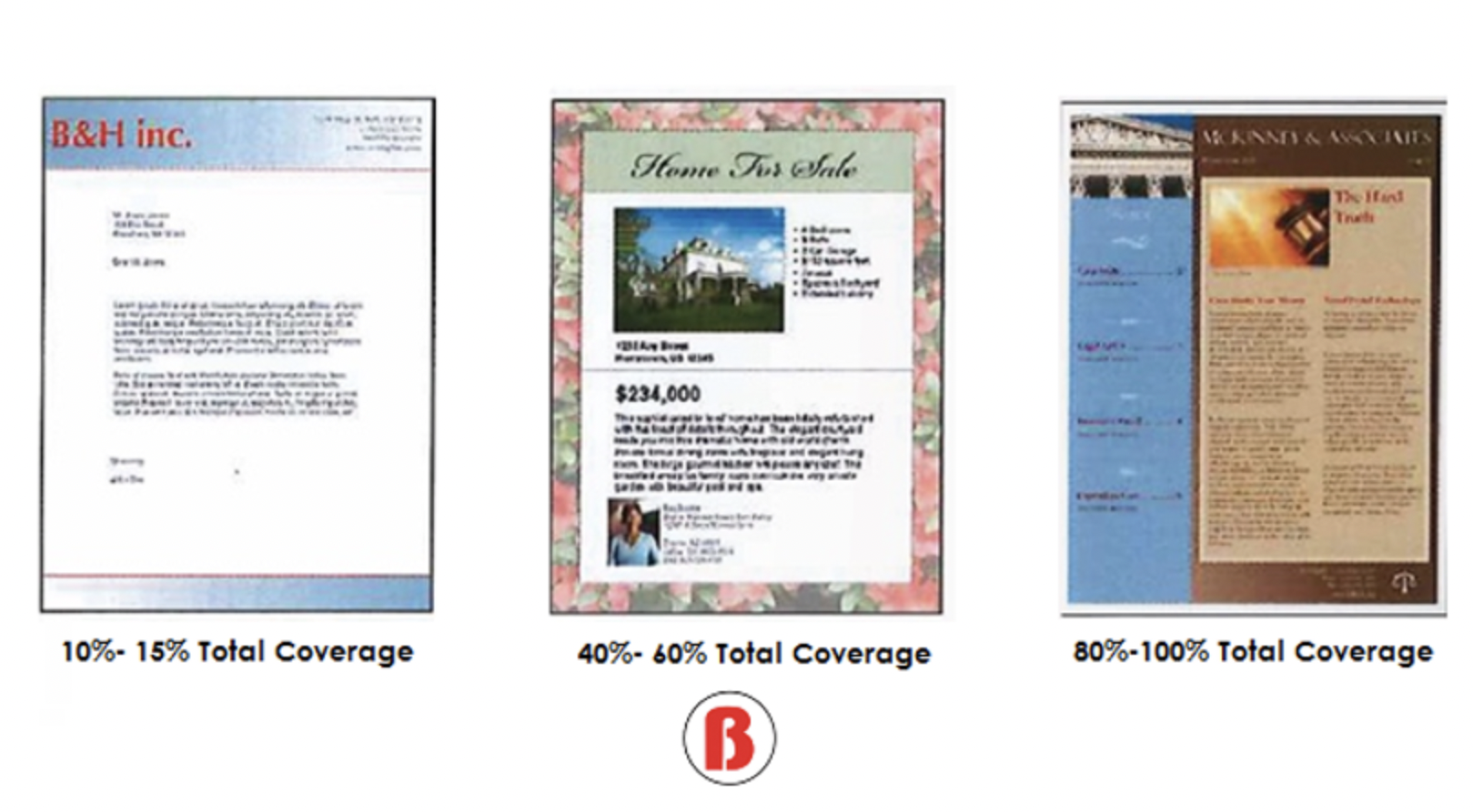
The page coverage used to rate most toner cartridges. Real office documents frequently run two to five times higher.
Why Your Actual Page Yield Looks Different
Several factors push your real yield above or below the rating. Page coverage leads the list, but it is not alone. Here are the drivers our Miami technicians see most often.
Page Coverage
This is the big one. Coverage is the share of the page touched by toner. Research puts the average for plain mono text between 4% and 6%, which lines up with the testing standard. So a clean text page tracks close to the rating. But add a dark header, a logo, a chart, or a full-bleed photo, and coverage climbs fast. Double the coverage and you roughly halve the pages.
Image Type and Layout
Two pages can share the same coverage percentage yet burn different amounts of toner. Why? Toner lays down thicker at the edges of printed areas than in the middle. Pages full of fine lines, dots, borders, and patterns have more edges, so they pull extra toner to hit the same visual coverage. Heavy design eats supplies.
Job Size
Bigger jobs are more efficient. Every time the printer spins up, it consumes a little toner before the first sheet lands. Print three single-page jobs and you pay this startup cost three times. Print one three-page job and you pay it once. So a few large runs stretch a cartridge further than many tiny ones.
Duplex, Paper Trays, and Exit Bins
Mechanical paths matter too. Duplex printing, or selecting trays and exit bins farther from the cartridge, keeps the engine running longer per page. More run time means more incremental toner loss. The effect is small per page, yet it adds up across a busy quarter.
Environment and Usage Patterns
Heat and humidity affect how toner behaves, and so does how often the device wakes up. Frequent short sessions, copy and fax modes, and routine calibration cycles all draw a bit of toner outside of actual printing. Miami humidity is real, and it belongs on this list.
How Manufacturers Actually Test Toner Yield
Curious how the box number gets made? It is more rigorous than you might guess. A lab loads a fresh cartridge into a qualified printer and prints a fixed test suite of standardized pages, continuously, until the cartridge reaches its end of life. Then technicians count the pages and average results across several cartridges.
The end-of-life trigger matters. Testing stops when print quality drops or the device declares the cartridge empty, whichever comes first. So the yield reflects a usable cartridge, not the last faint ghost of toner you can shake out by removing and rocking it.
Color adds a wrinkle. Under ISO/IEC 19798, each color cartridge gets a separate yield, since cyan, magenta, yellow, and black deplete at different rates depending on the test page mix. A composite color page can drain one channel long before the others. So your color device may demand a new cartridge while the other three still hold plenty of toner.
Why care about the method? Because it tells you what the number means and what it does not. The lab uses one printer model, one paper type, one steady climate, and one fixed image. Your office swaps paper, runs hot and humid, prints wildly varied jobs, and powers down nightly. Every one of those differences nudges your real yield away from the rating.
Why Color Pages Drain Toner So Much Faster
Black and white versus color is the single biggest swing in cost per page. A mono page touches one cartridge. A rich color page can touch four, and it usually carries heavier coverage to begin with. Stack those two effects and the math turns dramatic.
Consider a typical sales deck. Full-bleed photos, brand colors, gradient backgrounds. That page might run 30% coverage or more across multiple channels. Compared to a 5% mono memo, you could be spending five to ten times as much toner per sheet. Print 500 of them for a pitch and the supply hit is real.
None of this means color is bad. It means color belongs on the pages where it earns its keep. So route client proposals and marketing to a color device, and push internal drafts, contracts, and archives to a cheaper mono workhorse. Our Miami team sets these rules up as defaults, so the savings happen without anyone thinking about it. For shops weighing devices, our piece on managed print services shows how the routing works in practice.
Declared Yield vs. Actual Yield: A Quick Comparison
The table below shows how a single cartridge rated at 10,000 pages behaves as your real coverage climbs. Numbers are illustrative, but the pattern holds across brands.
| Real Page Coverage | What It Looks Like | Approx. Actual Yield | Effect on Cost Per Page |
|---|---|---|---|
| 5% (rated) | Light text memo | ~10,000 pages | Baseline |
| 10% | Text with a header and logo | ~5,000 pages | Roughly 2x |
| 15% | Reports with charts | ~3,300 pages | Roughly 3x |
| 20% to 25% | Graphics-heavy or color decks | ~2,000 to 2,500 pages | Roughly 4x to 5x |
See the trend? Cost per page is the metric to watch, not the cartridge price. A cheaper cartridge with a lower yield can quietly cost more per printed page than a pricier high-yield one.
What This Gap Costs Your Business
Most companies budget for toner by the cartridge. Smart ones budget by the page. When you only track unit price, a yield shortfall hides inside your supply spend and slowly inflates it.
Black-and-white click rates commonly land somewhere between a fraction of a cent and a nickel per page, while color runs higher because it pulls from multiple cartridges at once. So if your real coverage is double the rating, your effective cost per page doubles too, even though nothing on the invoice flagged it.
This is where measurement pays off. A structured print program tracks actual coverage, actual yields, and true cost per page across every device. Such visibility turns a fuzzy supply budget into a number you can defend. For a deeper look at the line items, our guide on business printing costs breaks it down, and how much a printer really costs covers the full picture beyond the cartridge.
Picture a small Doral firm running two color multifunction printers. Each prints about 8,000 pages a month. Sales believes coverage sits near 5%, so the budget assumes the rated yield. But a quick assessment shows real coverage closer to 14%, thanks to logos, color charts, and PDF reprints. The cartridges empty almost three times sooner than planned. That is not a billing error. It is a coverage reality nobody measured.
Multiply a small per-page miss across thousands of monthly pages and two devices, and the annual gap can run into real money. The good news? Once it is visible, it is fixable. Default duplex, pull-print release, and smart color routing routinely trim print volume by 15% to 20%, and bulk supply automation shaves more off the toner line.
Typical print and supply savings reported by well-run managed print programs, largely from right-sized devices, automated toner replenishment, and policies curbing wasteful printing. (Industry estimates; verify against your own baseline.)
How to Get More Pages From Every Cartridge
You cannot rewrite the laws of toner physics. But you can shrink the gap between declared and actual yield with a few habits.
None of these require new hardware. They just require knowing where the toner actually goes.
Why Automated Toner Replenishment Pays Off
Running out of toner mid-deadline is its own kind of expensive. Someone scrambles to a store, pays a premium for a standard-yield cartridge, and the device sits idle while everyone waits. So the hidden cost of a yield surprise is not just toner. It is downtime and panic pricing.
Modern devices report supply levels automatically. When a cartridge nears empty, a fresh one ships before you notice. No closet full of mismatched spares, no emergency runs, no overpaying. And because the supplier tracks usage across your fleet, you also get clean data on real yields by device, which feeds smarter budgeting next quarter.
There is a sustainability angle too. Bulk, scheduled delivery cuts rush shipments, and a good program recycles spent cartridges instead of landfilling them. So you trim cost and waste at the same time, which suits the growing number of South Florida firms tracking their environmental footprint. Barlop builds this into every print plan we manage.
How Barlop Business Systems Helps
We are a family-owned, woman- and minority-owned company, and we have served South Florida from our Doral headquarters since 1983. Here is how our team turns the yield question into real savings for Miami offices.
Print Assessment
We measure your real coverage, volumes, and cost per page across every device before recommending anything.
Auto Toner Delivery
Supplies ship before you run dry, so no panic orders and no overpriced emergency cartridges.
Local Service
Miami-based technicians keep Ricoh, Lanier, Sharp, and Brother fleets running at peak efficiency.
Cost-Per-Page Plans
One predictable rate bundling toner, parts, and service, billed by the page you actually print.
Right-Sized Fleet
We match devices to departments so heavy users get high-yield engines and light users do not overpay.
Greener Printing
Duplex defaults, recycling, and smarter coverage cut both waste and your supply bill.
Want the full menu of devices and supplies? Browse the Barlop equipment catalog, or ask us about a print assessment to see your true numbers.
Frequently Asked Questions
What is the difference between declared yield and actual page yield?
Declared yield is the lab-tested estimate printed on the box, measured at 5% page coverage under ISO conditions. Actual page yield is what you really get, which depends on your documents, settings, and environment. The two rarely match because real pages use more toner than the test page.
Why is toner yield measured at 5% coverage?
The 5% figure is the international testing baseline under ISO/IEC 19752 and 19798. It represents a light text page, giving every manufacturer a fair, repeatable way to publish comparable numbers. It was never meant to mirror heavy real-world printing.
What does 5% page coverage actually look like?
Roughly 14 lines of 11-point text on a letter page, with generous white margins and no images. A brief memo. Most invoices, reports, and marketing pages carry far more toner than this.
What is the difference between ISO 19752 and ISO 19798?
ISO/IEC 19752 is the standard for monochrome toner cartridges, and ISO/IEC 19798 is the standard for color toner cartridges. Both test at 5% coverage per color channel and report an average yield for comparison purposes.
Why did my cartridge run out faster than the box said?
Almost always higher page coverage. Logos, headers, charts, photos, and bold fonts lift coverage well above 5%, so the cartridge empties sooner. Job size, duplexing, calibration, and humidity also chip away at the total.
Does color printing use more toner than black and white?
Yes, usually a lot more. Color pages pull from cyan, magenta, yellow, and black cartridges together, and they tend to carry higher coverage. So color cost per page typically runs several times that of mono.
Are high-yield cartridges worth the higher price?
For busy devices, usually yes. High-yield cartridges cost more upfront but print more pages, which often lowers the cost per page. For a printer you barely use, a standard-yield cartridge may be the better value. Match the cartridge to the volume.
How can I lower my real cost per page?
Track coverage, batch jobs, use draft mode for internal pages, buy genuine high-yield supplies for heavy printers, and right-size your fleet. A managed print plan handles most of this automatically and reports your true cost per page.
Do third-party or remanufactured cartridges hit the same yields?
Sometimes, but quality varies widely. Reputable remanufactured cartridges can perform well, while bargain-bin toner from cold callers often underdelivers and can damage the device. Buy from a known supplier and test before you standardize.
Can Barlop help me figure out my true printing costs in Miami?
Absolutely. Barlop Business Systems runs a free print assessment for South Florida businesses, measuring real coverage and cost per page across your fleet. Call our Doral team at (786) 833-7781 and we will map your actual numbers, not the box estimates.
Does humidity in South Florida affect toner yield?
It can. Temperature and humidity influence how toner transfers and fuses, and Miami runs humid most of the year. Climate-controlled storage and routine maintenance help keep your real yields closer to the rating.
Is the declared yield on the box dishonest then?
No. The number is accurate for the test it describes. It just answers a lab question at 5% coverage, not your specific office workload. Read it as a comparison tool, then measure your own pages for the real story.
How do I check my real page coverage?
Many business printers and multifunction devices log coverage data internally, and fleet management software can pull it for you. Short of that, a print assessment samples your typical jobs and calculates an average. Once you know your real coverage, the yield gap stops being a mystery.
Does printing in draft or toner-save mode hurt quality?
For internal documents, rarely in any way that matters. Draft mode lays down less toner, so text looks a touch lighter but stays perfectly readable. Save the high-density settings for client-facing pages and you stretch every cartridge further.
Why does my color cartridge empty when it still looks full?
Color devices report each channel separately. One heavily used color, often black or cyan, can hit empty while the others sit near full. The printer flags the depleted channel, even though the cartridge body still holds toner you cannot use without risking print defects.
Read the Box, but Trust the Page
So the declared yield on your toner cartridge is honest. It is just answering a different question than the one you are asking. The box tells you how a cartridge performs in a lab at 5% coverage. Your real cost lives in your actual coverage, your job sizes, and your settings.
Once you measure those, the mystery disappears. And the visibility a print program from Barlop is built to give South Florida businesses is exactly what closes the gap. For broader IT and document workflow help, see our managed IT services too.
External references worth a look: the ISO standards body publishes the official yield testing methods, the Business Technology Association represents the office imaging industry, and the ENERGY STAR office equipment program covers efficiency.
Stop Guessing What Your Printing Really Costs
Let Barlop measure your real page yields and cost per page across every device. No pressure, just honest numbers.