Switching to a Modern Business Phone System: What Miami Companies Need to Know (Updated 2026)
Switching to a Modern Business Phone System: What Miami Companies Need to Know (Updated 2026) A practical roadmap for cloud VoIP migration, number porting, and zero-downtime cutover for South Florida businesses Serving Miami Since 1983 | 12 min read Quick […]
Cloud Communications Benefits for Business: How VoIP Transforms Miami Companies (2026 Guide)
Many businesses have invested large sums of money installing an on-premises business phone system. But an aging on-premises phone system can be hard to scale and complicated to manage during periods of business growth or consolidation. Further, on-premises phone systems require regular maintenance for everything from hardware updates, to surges in call volumes, business expansion, new offices, or service resolution. Over time, these support costs—often unexpected—can become very expensive.
VoIP, VoIP, Hooray! Your Guide to Internet Phone Service Providers
Discover the benefits of Internet phone service! Learn how VoIP works, save money, get advanced features, and choose the best provider.
Barlop Business Systems Teaches Customers What to Watch Out For When Taking Their Voice Technology to the Cloud
Barlop Business Systems Teaches Customers What to Watch Out For WhenTaking Their Voice Technology to the Cloud Leading Provider Educates Companies on the Proper Path Barlop Business Systems, a leading provider of unified communications, announced today that the company has […]
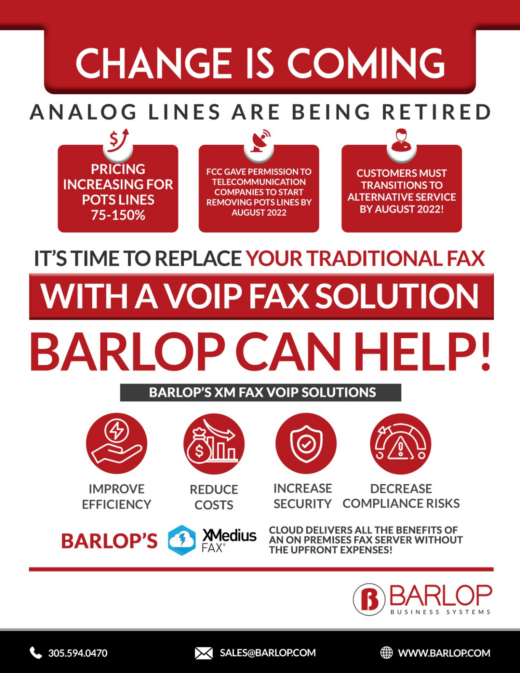
It’s Time to Upgrade Your Traditional Fax: Cloud Fax for Miami Businesses (Updated 2026)
Copper is going dark. Here is how cloud fax keeps your documents moving, your costs down, and your compliance intact. Serving Miami Since 1983 | 12 min read Quick Answer You should upgrade your traditional fax because the analog phone […]
Barlop Business Systems Educates Customers on How to Replace Manufactured Discontinued Phone Systems with Today’s Cloud Technology
Leader in Managed Technology Services Increases Customer Profitability by Cost Justifying New Cloud Voice Solutions MIAMI, FL – June 17, 2022 – Barlop Business Systems, a leader in managed technology services, announced today the company has launched a campaign to […]
Barlop Business Systems Launches SaaS Alerting Technology to Manage Common Business Applications
While technologies like G Suite, Salesforce, Slack, Dropbox, Office 365 or Box have be-come ubiquitous in the modern workplace, they unfortunately expose networks to certain vulnerabilities which can be prevented. While Barlop Business Systems’s particular technology monitors and alerts SMBs on up to 35 different types of cyberattack methods, many businesses are undereducated as to the 6 most common attacks.
Is Sustainability and New Technology Important in your Business?
Some companies are all about going Green and some are skeptical. While you can argue that some businesses use “going green” as a marketing ploy, it is a proven fact that sustainability offers true value by culturally impacting communities and […]