
AI Overview:
Voice and Unified Communications (UC) have evolved from basic phone systems into an integrated communication backbone that powers modern business. By combining voice, video, messaging, presence, and collaboration tools into a single platform, UC eliminates app-switching, breaks down communication silos, and supports hybrid and remote work.
Businesses benefit from faster collaboration, lower telephony and IT costs, improved productivity, and better integration with core systems like CRM and project management tools. As cloud-based UCaaS, AI features, and deeper customer-experience integration advance, unified communications are becoming a strategic driver of agility, efficiency, and long-term competitiveness.
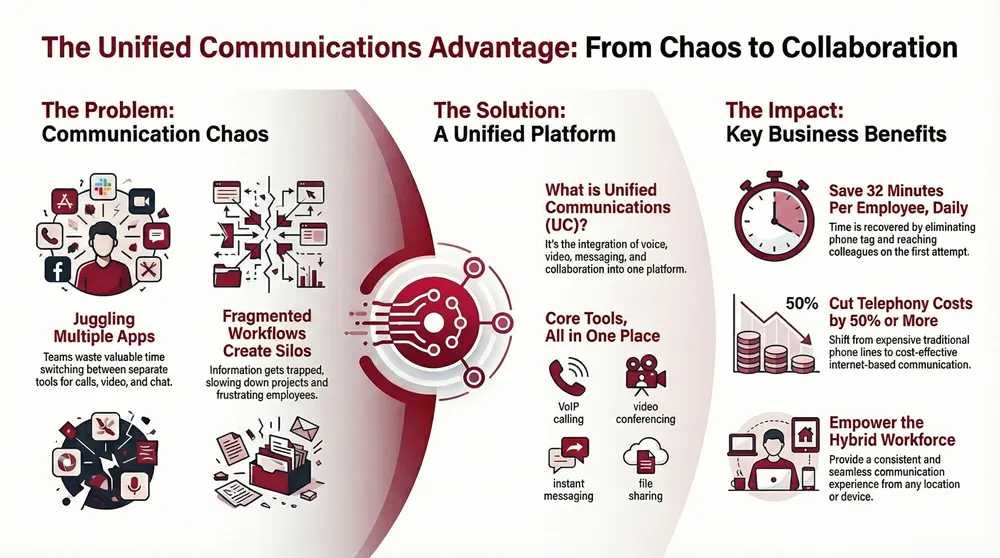
Why Voice and Unified Communications Are Reshaping Modern Business
Voice and unified communications have evolved from simple phone systems into the central nervous system of today’s workplace. This change addresses a critical challenge: the fragmented, inefficient communication tools that slow down teams and frustrate employees.
Quick Overview: Voice and Unified Communications
- What it is: Integration of voice, video, messaging, and collaboration tools into one platform
- Key benefit: Eliminates app-switching and communication silos
- Core components: VoIP calling, video conferencing, instant messaging, file sharing, presence indicators
- Delivery model: Available on-premises, cloud-based (UCaaS), or hybrid
- Primary goal: Create seamless communication experiences across all devices and locations
The old way of working – juggling separate apps for calls, emails, video meetings, and file sharing – is quickly becoming obsolete. As one industry expert noted: “The real power of UC isn’t in the tools themselves – it’s in how they transform organizational DNA. When communication flows seamlessly, innovation follows naturally.”
Modern businesses face mounting pressure to support hybrid workforces, improve productivity, and reduce operational costs. Nearly 1/3 of businesses already use unified communications, while another quarter plans to move to unified cloud communications in the next few years.
This shift isn’t just about technology – it’s about creating a more connected, agile workplace where teams can focus on meaningful work instead of wrestling with communication barriers.
Understanding Voice and Unified Communications
Communication is the heartbeat of every successful business, but what exactly happens when we bring all our scattered communication tools under one roof? Let’s break down what voice and unified communications really means and explore how it transforms the way teams connect and collaborate.
What is Unified Communications (UC)?
Picture this: you’re juggling five different apps just to have one conversation with your team. A phone call here, a video meeting there, some quick messages scattered across platforms, and files shared through yet another system. Sound familiar? That’s exactly the problem Unified Communications (UC) was designed to solve.
UC is the integration of multiple communication services into a single, cohesive solution. It’s not just one product you can pick up at the store – think of it more as a comprehensive strategy that brings together all your communication tools into one seamless experience.
Instead of hopping between separate apps for instant messaging, voice calls, video conferences, and file sharing, UC creates a unified workspace where everything flows naturally together. Unified communications is an evolving set of technologies that streamlines how people and devices communicate within a shared context.
The magic happens when you can start a conversation in chat, escalate it to a voice call with one click, then bring in a colleague via video – all without leaving your primary interface. This isn’t just convenient; it fundamentally changes how work gets done. More on UC solutions shows how this integration is revolutionizing the way businesses communicate.
VoIP and UC: The Foundation and the Framework
To understand where UC fits in the bigger picture, we need to start with Voice over Internet Protocol (VoIP). VoIP is the technology that lets you make phone calls over the internet instead of traditional phone lines. It converts your voice into digital packets, zips them across the internet, and reconstructs them as clear audio on the other end.
VoIP revolutionized business calling by dramatically reducing costs, especially for long-distance and international calls. But here’s where it gets interesting: VoIP serves as the foundation, while UC becomes the entire framework built on top of it.
Think of VoIP as the engine and UC as the complete vehicle. VoIP handles voice transmission beautifully, but UC takes those capabilities and expands them into a full collaboration ecosystem. Where VoIP focuses primarily on making and receiving calls, UC accepts the reality that modern communication involves much more than just talking.
| Feature Set | Standalone VoIP | Full Unified Communications (UC) Suite |
|---|---|---|
| Features | Voice (calls, voicemail, call forwarding) | Voice, Video Conferencing, Instant Messaging, Presence, File Sharing, Screen Sharing, Unified Messaging, CRM Integration |
| Primary Benefit | Cost Savings, Basic Phone Replacement | Productivity, Improved Collaboration, Streamlined Workflows |
| Ideal Use Case | Basic Phone System Replacement, Small Business | Comprehensive Communication for Hybrid Teams, Customer Service, Strategic Business Growth |
This comparison shows why many businesses are making the leap from basic VoIP to full UC platforms. While VoIP solves the “how do we make calls cheaper” problem, UC addresses the bigger question: “how do we help our teams work together more effectively?”
Key Components of a Modern UC System
A robust voice and unified communications system brings together several key technologies that work in harmony. Rather than viewing these as separate tools, think of them as interconnected parts of a communication ecosystem designed to make your workday smoother.
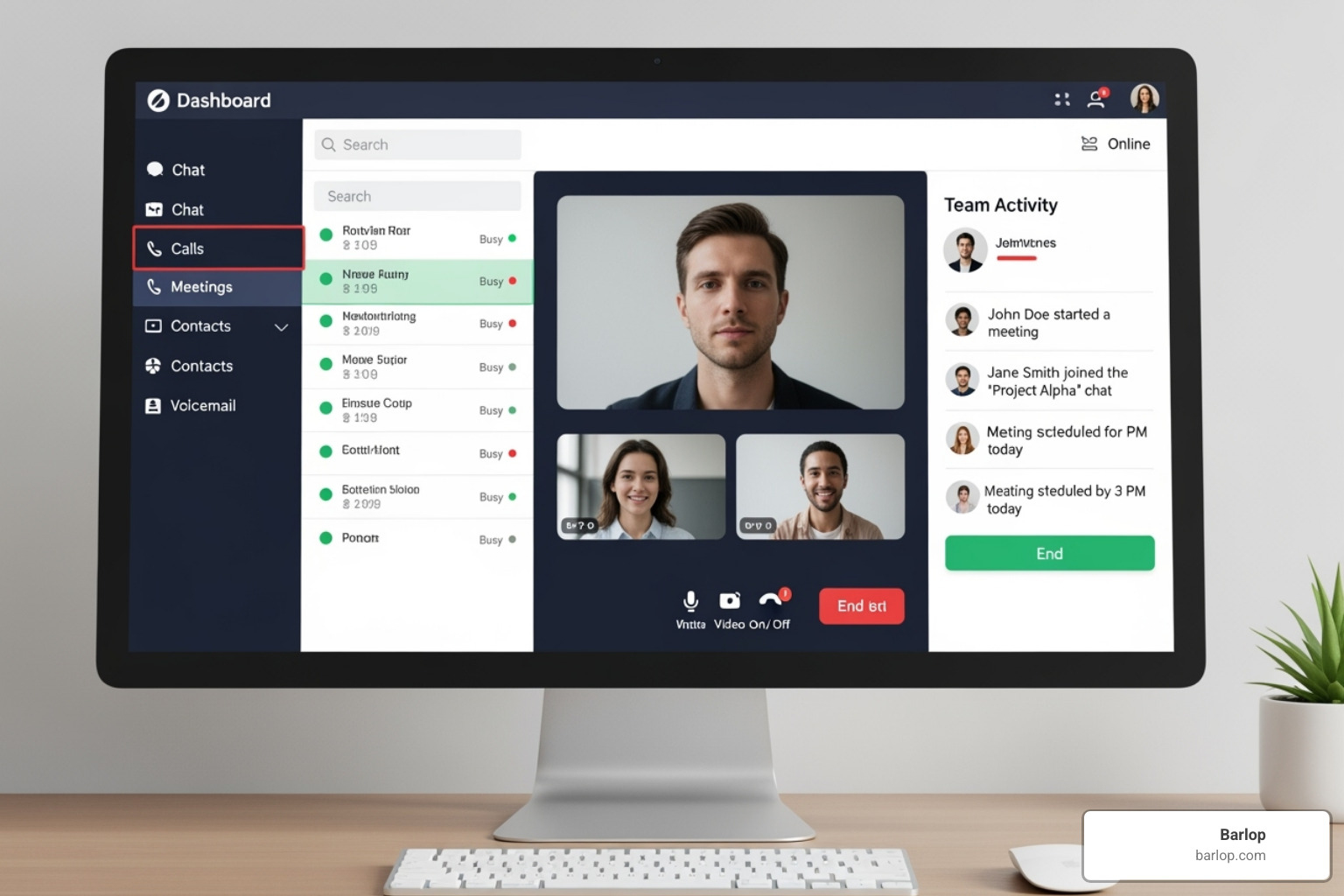
IP Telephony (VoIP) forms the backbone of voice communication, handling everything from basic calling to advanced features like call routing, voicemail, and interactive voice response systems. Video & Web Conferencing brings face-to-face interaction to distributed teams, offering high-definition video, screen sharing, and meeting recording capabilities that make remote collaboration feel natural.
Instant Messaging & Presence might seem simple, but these features are game-changers for workplace efficiency. Quick text exchanges keep conversations flowing, while presence indicators show whether colleagues are available, busy, or in meetings. This visibility helps teams communicate more thoughtfully and reduces the frustration of playing phone tag.
Unified Messaging creates a single inbox for all your communications. Imagine receiving voicemails transcribed as text in your email, alongside faxes and regular messages. Screen Sharing & Collaboration Tools enable real-time teamwork on documents and presentations, often including digital whiteboards and co-editing features that make remote collaboration feel as natural as working side-by-side.
Finally, Mobility through dedicated mobile apps ensures that all these capabilities travel with you. Whether you’re working from home, traveling, or simply away from your desk, you can access calls, chat, video meetings, and collaboration tools from your smartphone or tablet.
The beauty of a modern UC system lies not in any single component, but in how seamlessly they work together. You can start a project discussion in chat, quickly escalate to a voice call when things get complex, then invite additional team members to a video conference – all within the same platform, without missing a beat.
Why Unified Communications Drives Modern Work
The shift to voice and unified communications represents far more than swapping out old phone systems for newer technology. It’s about fundamentally reimagining how work gets done in the modern era. When communication barriers disappear, something remarkable happens: teams become more agile, costs drop significantly, and innovation flows more naturally throughout the organization.
Boosting Productivity and Cost-Efficiency
The financial impact of unified communications often surprises business leaders with its scope and speed. Companies consistently find that their investment pays dividends in ways they hadn’t initially considered.
Cost savings appear almost immediately when businesses move from traditional phone systems to UC platforms. The shift from expensive long-distance charges and complex infrastructure to internet-based communication can cut telephony costs by 50% or more. Travel expenses shrink as teams rely on high-quality video conferencing instead of face-to-face meetings for routine collaboration.
But the real magic happens in daily productivity gains. Research shows that employees using unified platforms save up to 32 minutes per day simply by reaching colleagues on the first attempt. No more phone tag, no more hunting through different apps to find the right person, no more delayed decisions because key team members were unreachable.
This time savings compounds quickly across an organization. A 100-person company could recover over 130 hours of productive time daily just from improved communication efficiency. That’s like adding three full-time employees without increasing headcount.
IT complexity reduction provides another layer of cost savings that many overlook. Instead of managing separate vendors for phone systems, video conferencing, messaging platforms, and collaboration tools, IT teams handle one integrated solution. This consolidation reduces maintenance overhead, simplifies troubleshooting, and frees technical resources for strategic projects that drive business growth.
3 Ways Cloud Communications Benefit Your Business explores these advantages in greater detail, showing how the right communication strategy becomes a competitive advantage.
Empowering the Hybrid and Remote Workforce
The pandemic didn’t create the need for flexible work arrangements—it simply accelerated a trend that was already reshaping the modern workplace. Today’s employees expect to work effectively from anywhere, and voice and unified communications platforms make this expectation a reality.
Work-from-anywhere flexibility becomes seamless when employees can access their complete communication toolkit from any location. Whether they’re at their office desk, working from home, or collaborating from a coffee shop, the experience remains consistent. Their business phone number follows them, video meetings work flawlessly, and team collaboration continues without missing a beat.
This consistency matters enormously for team dynamics. Remote workers often struggle with feeling disconnected from their in-office colleagues, but modern UC solutions bridge this gap effectively. Collaboration equity ensures that every meeting participant—whether sitting in the conference room or joining from across the country—can contribute equally to discussions and decision-making.
The change can be dramatic for organizations stuck with outdated systems. We’ve seen how helping companies transition from old phone systems open ups remote workforce potential that was previously constrained by technological limitations.
Talent acquisition and retention benefits follow naturally. When your communication infrastructure supports flexible work arrangements, you can recruit from a much broader geographic area and offer the work-life balance that top performers increasingly demand.
Enhancing Collaboration and Business Process Integration
The most sophisticated voice and unified communications implementations go beyond connecting people—they connect communication directly to business processes, creating workflows that feel almost effortless.
Breaking down communication silos happens organically when teams use integrated platforms. Information that once got trapped in email chains or separate messaging apps now flows freely across departments. Sales teams can instantly loop in technical experts during customer calls. Project updates shared in team chat automatically become visible to stakeholders who need that context.
Integration with core business applications transforms how work gets accomplished. When your UC platform connects with your Customer Relationship Management (CRM) system, customer service representatives see complete interaction histories the moment a call comes in. Project management integrations turn casual chat discussions into tracked action items. Calendar systems automatically schedule follow-up meetings based on conversation outcomes.
These integrations rely on APIs and custom workflows that adapt to your specific business needs. Rather than forcing your processes to fit generic software limitations, modern UC platforms flex to support how your organization actually operates. This customization capability means communication becomes a strategic business tool rather than just a utility service.
Perhaps most importantly, unified communications changes organizational culture in subtle but powerful ways. When information flows seamlessly and teams can collaborate without friction, innovation accelerates. Decisions happen faster because the right people can connect instantly. Problems get solved more creatively because diverse perspectives can contribute easily to discussions.
This cultural change—where communication becomes the foundation for agility and growth—represents the ultimate return on investment for voice and unified communications initiatives.
Practical Guide to UC Implementation and Management
Successfully implementing voice and unified communications is like orchestrating a complex symphony – every element needs to work in harmony. While the technology itself is powerful, the real magic happens when you plan thoughtfully, execute carefully, and focus on the human side of change.
Think of this as your roadmap to UC success. We’ll walk through the essential steps for selecting, implementing, and managing your UC ecosystem, addressing everything from vendor selection to security and user adoption.
Choosing the Right Voice and Unified Communications Solution
Selecting the right UC solution isn’t about finding the fanciest features or the lowest price – it’s about finding the perfect fit for your unique business needs. This decision will impact how your entire organization communicates for years to come.
Start by defining your business requirements clearly. What communication pain points keep your team frustrated? Are employees constantly switching between apps? Do remote workers feel disconnected? Are customer calls getting lost in the shuffle? Understanding these challenges helps you identify which UC features will make the biggest impact.
Your current network infrastructure is the foundation everything else builds on. UC platforms are hungry for bandwidth, especially when multiple people are on video calls simultaneously. You’ll need to evaluate whether your internet connection can handle the increased load and implement Quality of Service (QoS) policies to prioritize voice and video traffic over less critical data.
Planning for future growth and scalability prevents costly headaches down the road. Cloud-based UCaaS platforms shine here because they grow with you. Need to add fifty new users next month? No problem. Downsizing after a merger? Equally simple. This flexibility is especially valuable for growing businesses that can’t predict their exact communication needs two years from now.
Evaluating solutions and providers requires patience and thoroughness. Don’t rush this step – it’s worth spending time to get it right. Look for vendors with proven track records, robust security features, and customer support that actually answers the phone when you need help. Consider whether you want on-premises, cloud, or hybrid deployment. 5 Key Factors to Understand When Selecting a Cloud Voice Provider offers valuable insights to guide your evaluation process.
Understanding Total Cost of Ownership (TCO) prevents budget surprises later. That attractively low monthly subscription might not include implementation costs, training, ongoing maintenance, or necessary network upgrades. Factor in all these elements to get a realistic picture of your investment.
When it comes to voice and unified communications, security isn’t an afterthought – it’s the foundation that everything else depends on. Your UC platform will carry sensitive business conversations, confidential documents, and potentially regulated information that requires careful protection.
Zero-trust security models have become the gold standard for modern UC deployments. This approach assumes that no user or device can be trusted by default, whether they’re inside your office or working remotely. Every connection gets verified, every time. It might sound paranoid, but this approach prevents the kind of security breaches that make headlines.
End-to-end encryption protects your communications from prying eyes. Every voice call, video conference, and chat message should be encrypted from the moment it leaves one device until it reaches another. This prevents unauthorized access and eavesdropping, even if someone intercepts your data in transit.
Data sovereignty and residency considerations become crucial if you operate globally or in regulated industries. You need to know exactly where your communication data is stored and processed. Some regions have strict requirements about keeping data within specific geographical boundaries.
Meeting regulatory compliance requirements like HIPAA for healthcare or GDPR for data privacy means your UC solution must offer robust features for call recording, message archiving, and detailed audit trails. These aren’t just nice-to-have features – they’re legal requirements that can result in significant penalties if ignored. Improve Network Security Through Managed IT Services can help strengthen your overall security posture.
Overcoming Implementation Challenges for Successful Adoption
Even the most technically perfect UC deployment can fail if people don’t accept the new system. Success depends as much on managing the human side of change as it does on configuring the technology correctly.
Network performance and Quality of Service (QoS) issues can kill user enthusiasm faster than anything else. Nothing frustrates people more than choppy video calls or dropped phone conversations. Ensure your network can handle the increased load and implement QoS settings that prioritize voice and video traffic. Your users will judge the entire UC system based on call quality, so get this right from day one.
Integration complexity with existing software can seem overwhelming, but a strategic approach makes it manageable. Don’t try to integrate everything at once. Start with your most critical business applications – perhaps your CRM system or email platform – and leverage APIs or pre-built connectors to streamline the process. Success with initial integrations builds momentum for additional connections later.
Change management is your secret weapon for UC success. Too many organizations treat UC deployment as purely an IT project, forgetting that they’re fundamentally changing how people work and communicate. Communicate the benefits clearly, address concerns honestly, and involve key users in the planning process. When people understand why the change matters and feel heard throughout the process, they become advocates instead of resistors.
User training and empowerment determines whether your UC investment pays off. Don’t just flip the switch and expect everyone to figure it out. Provide comprehensive training that goes beyond basic features to show people how UC can make their specific jobs easier. Create easy-to-access resources like video tutorials and quick-start guides. Establish internal champions who can help their colleagues steer the new system. When users feel confident and empowered, they don’t just accept the new tools – they find creative ways to use them that you never anticipated.
Successful UC implementation isn’t about perfect technology – it’s about creating an environment where people can communicate more effectively than ever before.
The Next Wave: Future Trends in Voice and Unified Communications
The world of voice and unified communications never stands still. As we look ahead, exciting innovations are reshaping how we connect, collaborate, and communicate. These aren’t just flashy tech demos – they’re practical solutions that will transform your daily work experience in ways that might surprise you.

The Role of AI in Intelligent Communication
Artificial Intelligence is quietly revolutionizing UC platforms, turning them from simple communication tools into intelligent partners that anticipate your needs and improve your productivity.
Picture starting your workday with an AI-powered assistant that’s already reviewed your calendar, prepared meeting briefs, and even drafted responses to routine messages. These digital copilots are becoming reality, helping busy professionals stay on top of their communication without drowning in it.
The language barrier that once made international collaboration challenging is rapidly disappearing. Real-time transcription and translation now happen seamlessly during calls and video conferences. You can speak English while your colleague in Tokyo hears perfect Japanese, and vice versa. It’s like having a personal interpreter in every conversation.
Gone are the days of frantically scribbling notes during important meetings. Automated meeting summaries powered by AI capture key decisions, action items, and participant contributions, then deliver clean, organized summaries to everyone involved. This means you can focus on the conversation instead of worrying about missing crucial details.
Behind the scenes, predictive analytics are helping businesses work smarter. By analyzing communication patterns, AI can predict when customer inquiries will peak or when teams need additional collaboration resources. This insight helps companies optimize staffing and ensure smooth operations during busy periods.
Even the quality of your calls is getting an AI upgrade. Intelligent noise cancellation now filters out everything from barking dogs to construction noise, ensuring crystal-clear audio quality no matter where you’re working from. Industry recognition for leading UCaaS solutions often highlights these AI-improved capabilities.
The Convergence of UCaaS and Customer Experience Solutions
Something fascinating is happening in the communication world: the walls between internal collaboration and customer service are coming down. This convergence creates opportunities for businesses to deliver exceptional experiences both internally and externally.
Creating a unified experience means your customer-facing teams can leverage the same powerful UC tools as your internal departments. When a customer calls with a complex question, your support agent can instantly escalate from chat to video, then seamlessly bring in a product expert from engineering – all within one integrated platform.
This breakdown of barriers between internal teams and customer-facing roles transforms how businesses handle customer interactions. Instead of lengthy hold times while agents search for answers, internal experts can be pulled into customer conversations instantly. This improves first-call resolution rates and leaves customers feeling truly heard and valued.
The result is a dramatically improved customer journey where every touchpoint feels connected and informed. Businesses can track the entire customer experience, analyze interaction patterns, and provide increasingly personalized support that builds stronger relationships and loyalty.
Exploring Emerging Technologies: XR and Edge Computing
The future of voice and unified communications extends beyond traditional screens and speakers into entirely new dimensions of interaction.
Extended Reality (XR), which includes both Virtual Reality (VR) and Augmented Reality (AR), is making remote collaboration feel surprisingly intimate. Imagine conducting your next team meeting in a virtual conference room where everyone feels present, or collaborating on a product design by manipulating 3D models together in virtual space. These immersive experiences are making geographical distance irrelevant in ways video calls never could.
Supporting these rich experiences requires edge computing – a technology that processes data closer to where it’s needed rather than sending everything to distant cloud servers. For UC users, this means near-zero latency communication. Video calls respond instantly, virtual reality meetings feel natural, and real-time collaboration happens without the frustrating delays that break the flow of conversation.
The workplace itself is becoming smarter too. Intelligent meeting rooms and workspaces now automatically adjust lighting, acoustics, and display configurations based on who’s participating and what type of meeting is happening. These smart environments make technology invisible while ensuring every interaction is optimized for success.
These emerging trends point toward a future where communication isn’t just connected but truly intelligent, immersive, and responsive to human needs. The technology fades into the background while the human connections it enables become stronger and more meaningful than ever.
Frequently Asked Questions about Voice and Unified Communications
When businesses start exploring voice and unified communications, they often have similar questions about implementation, integration, and security. Let’s address the most common concerns we hear from organizations considering this transformative technology.
What is the main difference between UC and UCaaS?
Think of it this way: Unified Communications (UC) is the concept - the idea of bringing all your communication tools together into one seamless experience. It's the "what" you're trying to achieve: integrated voice, video, chat, file sharing, and collaboration features.
UCaaS (Unified Communications as a Service), on the other hand, is the delivery method - the "how" you get there. Instead of buying servers and software to run in your office, UCaaS providers host and manage everything in the cloud for you. You simply log in and start using the tools.
The beauty of UCaaS lies in its flexibility and scalability. Need to add 50 new employees next month? No problem - just update your subscription. Want to try new features? They're rolled out automatically. Plus, you avoid the headache of managing servers, updates, and maintenance. Your IT team can focus on strategic projects instead of keeping phone systems running.
Can I integrate a UC system with my existing business software?
Absolutely - and this is where UC really shines. Modern voice and unified communications platforms are built with integration in mind. They're designed to work seamlessly with the business tools you already rely on every day.
Most UC systems use APIs (Application Programming Interfaces) and pre-built connectors to link with your existing software. Picture this: when a customer calls, their record automatically pops up from your CRM system, giving your team instant context. Or imagine turning a quick chat discussion into a task in your project management tool with just one click.
The most common integrations include Customer Relationship Management (CRM) systems, Enterprise Resource Planning (ERP) tools, project management applications like Microsoft Teams or Slack alternatives, and productivity suites. Many platforms also connect with specialized industry software, whether you're in healthcare, legal services, or manufacturing.
The goal is to eliminate the frustrating app-switching that slows down your team. When everything talks to each other, your workflows become smoother and your employees more productive.
Is Unified Communications secure enough for a regulated industry?
This is a crucial question, especially for businesses in healthcare, finance, legal, or other regulated sectors. The short answer is yes - but with an important caveat: you need to choose the right provider and configure the system properly.
Leading voice and unified communications solutions offer enterprise-grade security features specifically designed for regulated industries. These typically include end-to-end encryption for all communications (voice, video, and chat), granular access controls that let you determine who can access what, multi-factor authentication, and secure data storage with detailed audit trails.
Many providers also maintain compliance certifications for industry-specific regulations like HIPAA for healthcare, GDPR for data privacy, and PCI DSS for payment processing. They understand that compliance isn't optional - it's essential for your business operations.
However, security is a shared responsibility. While your provider handles the platform security, you need to implement proper policies, train your users, and regularly review access permissions. Think of it like having a secure building - the provider gives you the locks and alarms, but you still need to make sure people use them correctly.
The key is thoroughly vetting potential providers during your selection process. Ask detailed questions about their security measures, compliance certifications, and how they handle data in your specific industry. A reputable provider will be transparent about their security practices and happy to demonstrate how they meet your regulatory requirements.
Conclusion
Voice and unified communications reveals something profound: we’re not just talking about upgrading technology – we’re witnessing a fundamental change in how businesses connect, collaborate, and thrive.
Think back to where we started. Those days of juggling multiple apps, missing important calls while stuck in email, and watching remote team members struggle to stay engaged in meetings. That fragmented communication landscape wasn’t just inefficient – it was holding back human potential.
The key insight is this: a unified platform doesn’t just streamline your tools; it empowers your people. When communication flows seamlessly, something magical happens. Teams become more agile. Ideas travel faster. Problems get solved quicker. Your entire organization becomes more responsive to opportunities and challenges alike.
We’ve seen how voice and unified communications delivers tangible benefits – saving up to 32 minutes per employee daily, reducing infrastructure costs, and enabling truly flexible work arrangements. But the deeper change is cultural. When information moves freely and collaboration becomes effortless, innovation follows naturally.
For businesses across Miami, Miami-Dade, Broward, and throughout Florida, this evolution isn’t just an opportunity – it’s becoming essential for staying competitive. The companies thriving today are those that have acceptd this shift, creating work environments where geography doesn’t limit collaboration and technology improves rather than hinders human connection.
At Barlop, we understand that navigating this change can feel overwhelming. That’s why we’re here to help you design and implement a communication strategy that truly drives success for your unique business needs.
Ready to transform how your team communicates and collaborates? Lift your business communication with our Unified Communications solutions.