
AI Overview:
This blog explains how cloud unified communications combine voice, video, messaging, and collaboration tools into one platform that cuts costs, removes on-premise hardware, and supports hybrid work. It highlights key benefits—scalability, stronger security, easier management, and predictable monthly pricing—while showing why Cloud UC is especially valuable for Canadian businesses needing compliance and reliability. The article also outlines essential features, integrations, security expectations, and simple steps for choosing the right provider. Finally, it notes how AI and emerging technologies will further improve communication and productivity.
Why Cloud Unified Communications Matter for Your Business
Cloud unified communications providers offer integrated platforms that combine voice, video, messaging, and collaboration tools into a single, cloud-based solution. These services help businesses streamline communication, reduce costs, and support modern work environments.
The market is filled with excellent providers, each with unique strengths. Some excel at deep integration with popular office productivity suites, while others are renowned for their video-first collaboration platforms. You’ll also find providers that focus on enterprise-grade security, strong global reach, or highly customizable solutions ideal for small businesses. The key is to find a provider whose strengths align with your company’s unique needs.
The global unified communications market is booming – valued at $101.34 billion in 2022 and projected to reach $246.57 billion by 2030. This growth is driven by the shift to remote work and the need for flexible communication tools.
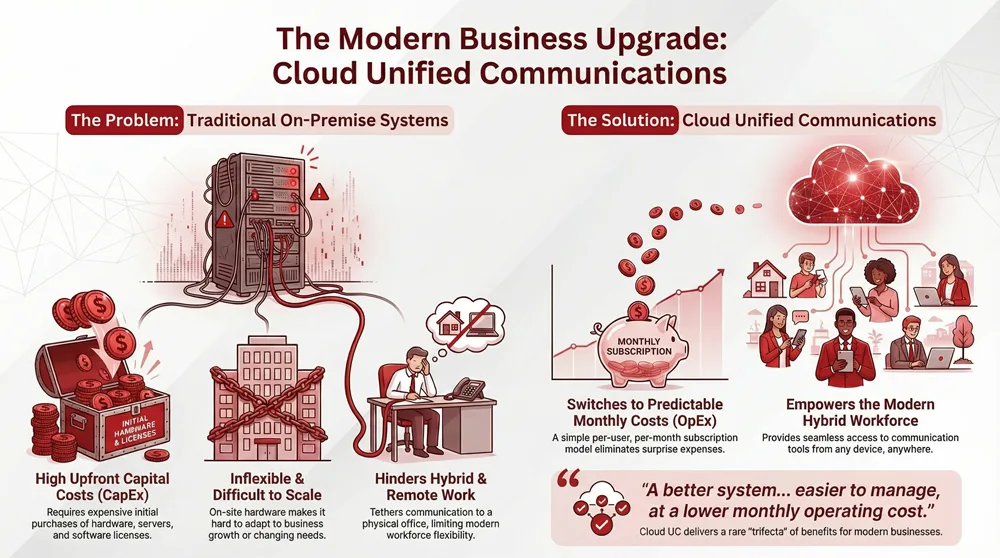
As one business leader put it: “It’s rare to see a trifecta in the IT world where you have a better system providing advanced features, while being easier to manage, at a lower monthly operating cost.”
Modern businesses face a simple choice: stick with outdated, expensive on-premise systems or accept cloud solutions that offer better features at lower costs. The answer is clear when you consider that cloud UC eliminates hardware maintenance, provides automatic updates, and scales with your business growth.
For Canadian businesses especially, cloud unified communications solve critical challenges like supporting hybrid workforces, ensuring business continuity, and meeting compliance requirements while keeping data within Canadian borders.
Why Cloud UC is a Game-Changer for Canadian Businesses
Gone are the days when a business phone system meant a closet full of blinking hardware and a dedicated IT team just to keep the lines open. For Canadian businesses, the shift from traditional on-premise communication solutions to cloud unified communications is not just an upgrade; it’s a fundamental change that impacts every facet of operations. We’re talking about a complete overhaul that brings significant cost savings, unparalleled scalability, and the kind of flexibility that modern work demands.
Cloud UC empowers our teams to collaborate more effectively, no matter where they are, leading to a noticeable increase in productivity. When communication channels are seamlessly integrated, tasks get done faster, decisions are made quicker, and our customers experience a smoother, more responsive interaction. Think of it as trading a clunky, expensive landline for a sleek, all-in-one smartphone that handles calls, video, messaging, and all your apps – that’s the jump we’re making with cloud unified communications.
From High Upfront Costs to Predictable Subscriptions
One of the most compelling arguments for cloud unified communications, especially for businesses in places like Miami, Miami Dade, Broward, Florida, and Fort Lauderdale, is the dramatic shift in cost structure. Traditional on-premise systems require a substantial Capital Expenditure (CapEx). This means purchasing expensive hardware, servers, and software licenses upfront. Then comes the ongoing Operational Expenditure (OpEx) for maintenance, upgrades, and the IT staff needed to manage it all. It’s like buying a house and then realizing you also need to build a whole new infrastructure just to live in it.
With cloud UC, this changes entirely. Instead of a hefty upfront investment, we pay a predictable, per-user, per-month subscription fee. This “pay-as-you-grow” model means we only pay for what we use, allowing us to scale our communication infrastructure up or down with ease. No more worrying about server failures, software updates, or unexpected repair bills. The cloud provider handles all the infrastructure, maintenance, and security, freeing up our resources and converting unpredictable CapEx into manageable OpEx. This financial agility is a huge benefit, allowing us to invest more in our core business and less in managing complex IT systems.
Empowering the Modern Hybrid Workforce
The landscape of work has fundamentally changed, and Canadian businesses are at the forefront of embracing remote and hybrid models. This shift isn’t just a trend; it’s a strategic necessity, and cloud unified communications are the backbone enabling it. Our teams need to connect and collaborate seamlessly, whether they’re working from a home office in Toronto, a co-working space in Vancouver, or the main office in Montreal. Cloud UC provides the geographic flexibility and device agnosticism required for this new reality. Employees can access all communication tools – voice, video, chat, and files – from any device, anywhere, as long as they have an internet connection.
This flexibility also significantly improves business continuity. If a local office faces an outage or disruption, our operations don’t grind to a halt. Communication simply reroutes through the cloud, keeping our teams connected and productive. This resilience is invaluable. As we’ve learned, building the best hybrid work environment is about more than just technology; it’s about fostering connection and productivity. Cloud UC solutions play a pivotal role in creating a cohesive and efficient hybrid workplace, helping businesses transition from old phone systems that hindered remote worker performance.
Essential Features of Top-Tier Cloud Unified Communications Providers
When we evaluate cloud unified communications providers, we’re not just looking for a new phone system. We’re seeking a comprehensive ecosystem that integrates every aspect of our business communication. The best providers offer a robust suite of features designed to improve collaboration, streamline workflows, and provide actionable insights. It’s about having a unified platform where every communication tool works in harmony, backed by solid security and intuitive administration. This means you get detailed analytics to understand usage and performance, alongside straightforward administration tools that make managing your system a breeze.

Core Communication & Collaboration Tools
At the heart of any effective cloud UC solution are the fundamental tools that enable day-to-day communication. We expect crystal-clear HD Voice for all calls, ensuring every conversation is heard without distortion. Imagine never having to ask, “Can you hear me now?”!
Video conferencing capabilities are no longer a luxury but a necessity, allowing us to connect face-to-face with colleagues and clients, whether across the city or across the globe. Features like screen sharing, virtual backgrounds, and recording are standard, making virtual meetings just as productive as in-person ones.
Team chat and instant messaging keep internal communication flowing, reducing email clutter and fostering quick, informal collaboration. File sharing integrated within these chat platforms means documents and media can be exchanged instantly and securely. A robust VoIP phone system, accessible from desktop or mobile apps, replaces traditional desk phones, giving our employees the flexibility to make and receive calls from anywhere. This comprehensive suite of tools truly makes it easy to transition to a modern phone system, simplifying communication and boosting efficiency. Barlop Makes it Easy to Transition to a Modern Phone System
Critical Business Integrations
A truly powerful cloud unified communications solution doesn’t operate in a vacuum. Its value multiplies when it integrates seamlessly with the other business applications we use daily. Imagine a scenario where a customer calls, and before you even answer, their entire history from your Customer Relationship Management (CRM) system pops up on your screen. That’s the power of CRM integration!
Similarly, integration with Enterprise Resource Planning (ERP) systems can streamline operations by connecting communication data with financial, supply chain, and human resources information. This means less manual data entry and more accurate, real-time insights across your entire business.
The best cloud unified communications providers offer extensive integration capabilities, often through robust Application Programming Interfaces (APIs) and comprehensive app marketplaces. These integrations mean our productivity tools are always connected, allowing us to automate tasks, reduce manual data entry, and gain a holistic view of our customer interactions and internal processes. This interconnectedness is key to opening up new levels of efficiency and responsiveness, turning your communication platform into a central hub for all your productivity tools. productivity tools
What Security Should Cloud Unified Communications Providers Offer?
In today’s digital landscape, security is paramount, especially when dealing with sensitive business communications. When considering cloud unified communications providers, we must prioritize those that offer stringent security measures. This starts with end-to-end encryption for all voice, video, and messaging traffic, ensuring that our conversations remain private and secure from eavesdropping. Think of it as a locked, private line just for your team.
Data sovereignty is another critical consideration for Canadian businesses. We need to ensure that our communication data is stored and processed within Canadian data centers, complying with local privacy regulations like the Personal Information Protection and Electronic Documents Act (PIPEDA). Reputable providers will explicitly state their compliance with these standards, giving you peace of mind.
Beyond encryption and data residency, we look for providers that guarantee high uptime Service Level Agreements (SLAs), often 99.999%, meaning minimal disruption to our services. Features like two-factor authentication (2FA) add an extra layer of security, protecting accounts from unauthorized access. For industries dealing with highly sensitive information, such as virtual healthcare, compliance with specific regulations is a strong indicator of a provider’s commitment to robust security. We want to be confident that our communications are not just efficient but also impenetrable. Cloud Services for Virtual Healthcare
How to Choose the Right Partner for Your Business
Selecting the ideal cloud unified communications providers is a big decision, one that can significantly shape your business’s future. It’s definitely not a “one-size-fits-all” situation. To make the very best choice, we need a thoughtful, step-by-step approach. This involves careful assessment of our own needs, thorough evaluation of potential partners, and meticulous planning for the transition. Think of it like choosing a new headquarters: you wouldn’t just pick the first building you see without doing your homework!
Step 1: Assess Your Company’s Unique Requirements
Before we even start looking at different providers, the most important first step is to clearly define what we need. Our team size, our current work model (are we fully remote, a mix of hybrid, or mostly in-office?), and any specific industry needs will greatly influence the features and support we require. For example, a new startup might prioritize ease of use and sticking to a tight budget, while a larger, established company could need advanced contact center features and deep integrations with existing software.
Our budget, both for the initial setup and the ongoing monthly subscriptions, is always a key factor. Just as important is thinking about scalability. Will the solution grow smoothly with us as we expand, adding new team members or opening new locations without any bumps in the road? We need a provider who can truly support our future growth, not just our current situation. This upfront assessment is crucial, as it lays the groundwork for understanding the 5 Key Factors to Understand When Selecting a Cloud Voice Provider.
Step 2: Understand Different Provider Models
The market for cloud unified communications is quite varied, offering different ways to get these solutions. We can choose to work directly with large, well-known vendors. Or, we might partner with resellers, who often offer more personalized service and local support, which can be a real plus. Independent consultants can provide objective advice, helping us steer the sometimes-complex choices. Increasingly, Managed Service Providers (MSPs) play a vital role, giving end-to-end support from setting things up to managing them every day.
MSPs, especially those with a strong presence in your local region, can be incredibly valuable partners. They often have deep expertise in integrating cloud UC with your existing IT Services, ensuring a smooth transition and continuous optimization. They provide important strategic guidance, helping us get the most out of our UC solution, and they handle the daily management so we can focus on what we do best: running our core business. This comprehensive support can make a huge difference in how successful your cloud UC deployment turns out to be.
Step 3: Plan for a Smooth Migration
Moving to a new cloud unified communications system, while incredibly beneficial, does come with its own set of challenges. Planning for a smooth transition is absolutely essential to minimize any disruption and make sure our team adopts the new system quickly and easily. Common challenges include helping employees get comfortable with the change, ensuring seamless data porting (which means keeping our existing business phone numbers), and confirming our network is ready to handle the increased voice and video traffic.
We need to make sure there are plenty of training resources available for our teams so they can quickly adapt to the new platform. A phased rollout, rather than trying to do everything at once, can help us identify and fix any issues early on, allowing for adjustments along the way. This careful planning ensures that our journey to the cloud is as smooth as possible, turning what might seem like a daunting task into a manageable and successful project. As we’ve learned from businesses adopting VoIP, good preparation is key to a successful transition.
The Future of Unified Communications: AI and Beyond
The world of communication never stands still, and cloud unified communications are at the very edge of this constant change. Artificial Intelligence (AI) is leading the way, pushing what’s possible even further. We’re already seeing super smart AI assistants that do more than just write down what’s said on a call.
Imagine having a tool that can tell you how a customer is feeling during a chat or call in real-time (sentiment analysis). Or, picture walking out of a long meeting and having a perfect meeting summary waiting for you, maybe even with draft follow-up emails ready to go. This isn’t just about computers doing tasks; it’s about AI helping us be better at our jobs, making our teams much more efficient and quick to respond.
But the future goes beyond just AI. We’ll see deeper integrations between our communication tools and all the other apps we use every day. Think about your communication platform knowing your schedule or what projects you’re working on. It could then help you connect with the right people or find the information you need, almost before you even ask!
Also, get ready for Extended Reality (XR). This means virtual meetings could become truly immersive. Instead of just seeing faces on a screen, you might feel like you’re actually in the same room, no matter where everyone is located. And let’s not forget the improved mobile experience. Our phones are already powerful, but they’ll become even better for work, making sure we can connect and be productive from anywhere, easily and smoothly. The future of unified communications is bright and full of exciting changes that will keep reshaping how we work and interact.
Frequently Asked Questions
It’s natural to have questions when considering a big step like upgrading your business communications. We’ve gathered some of the most common inquiries to help you steer cloud unified communications with confidence.
What is the difference between UC and UCaaS?
This is a fantastic question that often comes up! Think of it this way: Unified Communications (UC) is the grand vision – it’s about bringing all your different communication tools, like voice calls, video meetings, and chat messages, together into one seamless, cohesive platform. It's the "what" you're trying to achieve: a unified communication experience.
Now, Unified Communications as a Service (UCaaS) is the "how" you get there, especially in today's cloud-first world. UCaaS is simply the delivery model for those integrated UC solutions. It means a dedicated provider hosts and manages all the complex infrastructure, software, and maintenance for you, delivering it as a service over the internet. You just subscribe, and they handle the heavy lifting. It's like streaming your favorite movies (UCaaS) instead of buying and maintaining a whole collection of DVDs (on-premise UC). Simple, right?
How much do cloud unified communications cost?
Ah, the million-dollar question! The truth is, the cost of cloud unified communications isn't a one-size-fits-all number, but it's typically far more predictable and budget-friendly than traditional systems. Prices will naturally vary based on a few key factors:
The specific provider you choose: Different providers offer different feature sets and service levels.
The number of users you have: Most plans are priced on a per-user, per-month basis.
The features you need: Basic plans might cover voice and chat, while premium plans could include advanced analytics, contact center features, or deep integrations.
The beauty of cloud UC is that it shifts your spending from a huge, unpredictable Capital Expenditure (CapEx) – like buying a massive phone system outright – to a manageable, predictable Operational Expenditure (OpEx). You pay a clear, per-user, per-month subscription fee. This means no more worrying about large upfront investments, unexpected maintenance costs, or expensive upgrades. It makes budgeting a breeze and allows your business to scale its communication infrastructure up or down as needed, without financial strain.
Can I keep my existing business phone numbers when switching providers?
Absolutely, in most cases, you can! We understand that your established business phone numbers are vital to your brand and customer connections. The process for keeping them when you switch to a new cloud unified communications provider is called "number porting."
Reputable cloud unified communications providers are experts at this. They will manage the entire transition for you, working diligently behind the scenes to ensure your existing phone numbers are seamlessly transferred to your new cloud system. This means you can upgrade your communications technology without any interruption to your incoming calls or the need to update all your business cards and marketing materials. It’s a smooth, worry-free process designed to keep your business connected.
Conclusion
So, as we’ve seen, choosing the right cloud unified communications providers for your business isn’t just about getting a new phone system. It’s a truly strategic step that touches every part of your operation, from how efficiently your team works day-to-day to your company’s potential for growth in the years to come.
We’ve explored how cloud UC can bring fantastic benefits: think predictable costs instead of big surprises, the ability to scale up or down with ease, and how it truly empowers your hybrid workforce to connect from anywhere. We also highlighted how these solutions bolster your security, keeping your sensitive conversations safe.
We also dove into the must-have features you should look for and walked through a practical guide on how to pick the perfect partner. It all starts with understanding your unique needs and making a solid plan for a smooth transition.
And the journey doesn’t stop here! The future of unified communications, especially with exciting advancements in AI, promises even more incredible ways to collaborate and boost efficiency. By embracing cloud UC now, you’re not just tackling today’s communication problems; you’re actively future-proofing your business and setting yourself up for lasting success in our ever-connected world.
Ready to make the leap? Partnering with an experienced expert like Barlop can truly simplify this transition, making sure you pick a solution that fits your business goals like a glove.
Lift your business with fully integrated Unified Communications