
AI Overview:
This blog shows how cloud based calling replaces traditional phone systems with an internet-powered, flexible, and cost-efficient communication platform. It explains how VoIP, cloud PBX, and UCaaS allow businesses to make calls, host video meetings, and message from anywhere—ideal for remote and hybrid teams. The article highlights benefits like lower costs, easy scalability, mobility, and advanced features such as auto-attendants, call routing, analytics, and CRM integration. It also covers key migration steps, reliability and security requirements, and how AI tools like call transcription, summaries, and sentiment analysis make cloud calling smarter and more productive.
Why Cloud Based Calling is Revolutionizing Business Communication
Cloud based calling has transformed business communication, replacing traditional phone systems with internet-powered solutions that offer greater flexibility, cost savings, and advanced features. Here’s what you need to know:
Key Features of Cloud Based Calling:
- Voice over Internet Protocol (VoIP) – Converts voice to digital data sent over the internet
- No hardware required – Hosted by third-party providers in the cloud
- Unified Communications – Combines voice, video, messaging, and collaboration tools
- Remote accessibility – Make and receive calls from anywhere with internet
- Advanced features – Auto-attendant, call routing, analytics, and CRM integration
The shift from landlines to cloud solutions is a business necessity. With an estimated 36.2 million Americans working remotely by 2025, companies need communication systems that support distributed teams.
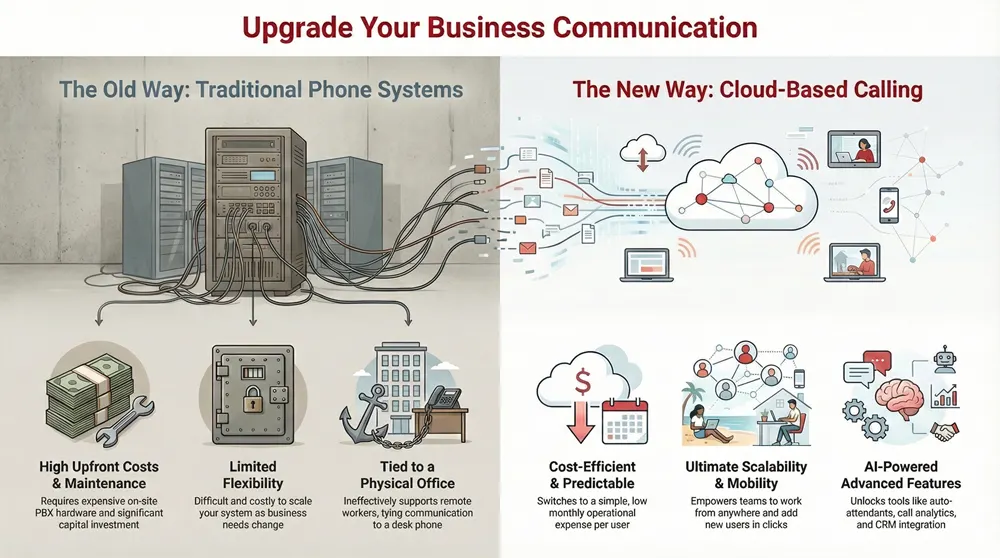
Traditional Private Branch Exchange (PBX) systems require expensive on-premise hardware and significant upfront costs. Cloud based calling eliminates these barriers by moving your entire phone system to the internet.
The technology works through Unified Communications as a Service (UCaaS), which integrates multiple communication channels into a single platform. This allows your team to seamlessly switch between voice calls, video meetings, and messaging from one interface. For businesses in the Miami area, this represents a significant opportunity to reduce IT complexity while improving team collaboration.
How Cloud Calling Works: The Technology Behind the Conversation
At its heart, cloud based calling relies on Voice over Internet Protocol, or VoIP. This technology transforms your voice into digital packets that travel over the internet, much like an email. This fundamental shift frees businesses from the constraints of traditional phone lines.
The magic of cloud based calling is its infrastructure. Instead of a large, on-premise Private Branch Exchange (PBX) system, your entire phone system is hosted off-site by a provider. This eliminates complex wiring, dedicated IT staff for phones, and physical hardware for you to maintain. Everything is managed remotely and securely in the cloud.
This provides incredible flexibility. Your team can access the business phone system from anywhere using various endpoints, such as a desk IP phone, a softphone application on a computer, or a mobile app. Whether an employee is in your Fort Lauderdale office, their home in Miami Dade, or traveling, they remain connected to your main business line.
This setup transforms your phone system into a cloud PBX, which remotely handles all calls, voicemails, and advanced features. It’s the powerful engine ensuring every call is clear and every feature works flawlessly. To learn more about the software behind these solutions, see our guide: Company Communication Software.
To see the difference, let’s compare cloud based calling to its traditional counterpart:

Core Components of a Cloud Phone System
A robust cloud based calling system starts with a trusted third-party provider, like Barlop, who manages the complex cloud infrastructure and technical heavy lifting. This gives you the benefits of a sophisticated system without the management overhead.
Your primary responsibility is a stable internet connection. The quality of your internet directly impacts call clarity. Quality of Service (QoS) settings are crucial here; they prioritize voice traffic over other data, ensuring your conversations remain smooth and uninterrupted, even on a busy network.
Another key component is softphone applications. These programs turn computers, tablets, or smartphones into fully functional business phones. This allows your team to use existing devices, saving you from purchasing dedicated hardware for every employee. Choosing a provider with managed services ensures these components work perfectly. Learn more here: Does Your Business Communications Provider Offer Managed Services?
Understanding UCaaS and its Role
Cloud based calling is a key part of a broader concept called Unified Communications as a Service (UCaaS). UCaaS integrates all your essential communication tools—voice calls, video conferencing, instant messaging, and file sharing—into one seamless platform.
This single-platform approach is powerful. Instead of juggling multiple apps, your team has everything in one place. This streamlines workflows, reduces context switching, and boosts productivity by making communication and collaboration effortless across your organization, whether your team is in Miami, Broward, or beyond.
The Core Benefits of Cloud Based Calling for Modern Businesses
Embracing cloud based calling gives your business a powerful advantage, making it more agile, resilient, and productive.
One of the most significant benefits is cost-efficiency. Traditional phone systems involve large upfront capital expenses (CapEx) for hardware and installation. With cloud based calling, you switch to a predictable monthly operational expense (OpEx) per user. This eliminates large investments in equipment and reduces maintenance costs, as your provider handles the technical side.
Next is scalability and flexibility. Growing your business? Adding new users to your phone system takes just a few clicks. Need to scale down? That’s just as easy. This adaptability is something legacy systems can’t match, allowing your business to respond quickly to changing needs.
For companies with remote or hybrid teams, cloud based calling offers superior mobility. Your team can make and receive business calls from anywhere with an internet connection. This is crucial for business continuity, ensuring operations continue smoothly even during events like an office power outage. We’ve helped many businesses make this transition: Barlop Business Systems Helps Companies Transition from Old Phone Systems That Hindered Remote Worker Performance.
Cloud calling also provides global reach. Many providers offer local numbers in different regions, helping you establish a presence without a physical office, boosting productivity and market reach. Find more benefits here: 3 Ways Cloud Communications Benefit Your Business.
Empowering a Distributed Workforce
Cloud based calling is ideal for the modern, distributed workforce. Employees can work from anywhere using a single business number that rings on their desk phone, computer, or mobile device. This ensures clients can always reach them, maintaining professionalism and accessibility. The power of mobile and desktop apps turns any device into an extension of your office phone system, which is vital for keeping teams productive. For comprehensive solutions, explore our offerings: Company Communication Solutions.
Gaining a Competitive Edge with Advanced Features
Cloud systems include advanced features that give your business a competitive edge:
- Auto-attendant (virtual receptionist): Greets callers with a custom menu to direct them to the right person or department, creating a professional first impression.
- Call routing and queues: Directs calls based on rules you set and holds callers in a queue with custom messages, improving customer satisfaction.
- Call recording and analytics: Record calls for training and quality assurance. Analytics provide insights into call volumes, team performance, and customer sentiment.
- Voicemail-to-email transcription: Converts voicemails to text and sends them to your email, saving time.
- CRM integration: Connects your phone system with your CRM platform. When a customer calls, their record can pop up automatically, enabling personalized service.
- CTI pop-ups (Computer Telephony Integration): Shows customer information on-screen as a call comes in, making every interaction more informed.
Implementation and Security: Migrating to the Cloud with Confidence
Making the switch to a cloud based calling system can be a smooth journey with proper planning and the right partner. Our goal is to guide you through the process with minimal disruption to your daily operations.
The process begins with assessing your current setup and needs. A key part of this is number porting, which allows you to keep your existing business phone numbers. This avoids the hassle of updating business cards or notifying customers of a new number. We handle the coordination to make it effortless for you.
Next, we evaluate your internet connection. A stable, high-speed connection is crucial for clear calls. We’ll help you determine the necessary bandwidth to ensure your team sounds great on every call.
Choosing the right provider is also a critical piece of the puzzle. You need a partner with a proven track record, reliable technology, and excellent support. We’ve put together some tips on what to look for when moving your voice technology to the cloud: Barlop Business Systems Teaches Customers What to Watch Out For When Taking Their Voice Technology to the Cloud.
Key Considerations for Implementing Cloud Based Calling
Before you migrate, it’s important to perform a detailed cost analysis, comparing your current expenses with the predictable monthly fees of a cloud system. You should also identify must-have features for your team and consider your growth plans.
Integration capabilities are also vital. Ensure your new system can connect with the tools you already use, like your CRM or helpdesk software. Seamless integration opens up significant efficiencies.
Finally, plan for user training. While most systems are intuitive, proper training ensures your team can leverage all the features to their fullest potential, leading to immediate productivity gains. To help you choose wisely, review our guide: 5 Key Factors to Understand When Selecting a Cloud Voice Provider.
Ensuring Reliability and Security
When trusting your business calls to the cloud, reliability and security are paramount. Look for a strong Service Level Agreement (SLA). Many top providers offer 99.999% uptime, meaning your phone system is almost always available.
Security is another top priority. Modern cloud based calling platforms use strong encryption standards like SIP over TLS and AES 256-bit to protect your conversations. A good provider will also comply with regulations like HIPAA and GDPR and have robust access controls and disaster recovery planning in place. This keeps your business resilient and your data secure.
The Next Generation: AI and Analytics in Cloud Communications
The evolution of cloud based calling is moving toward smarter communication, where Artificial Intelligence (AI) and advanced analytics turn every conversation into a source of business intelligence. Your communication system becomes a tool that helps you understand customers and improve operations. We’ve launched a cloud voice program that harnesses these technologies to help businesses leverage the future, today: Barlop Business Systems Launches a Revolutionary Full Service Cloud Voice Program.

How AI is Changing Business Calls
AI is actively reshaping how businesses handle calls, turning conversations into valuable data.
For example, AI provides real-time transcription and post-call summaries. This allows you to focus on the conversation, knowing an accurate record is being created. After the call, AI generates concise summaries with key points and action items, simplifying follow-ups.
AI can also perform sentiment analysis to gauge a customer’s emotional tone (happy, frustrated, etc.), which is invaluable for improving service. Furthermore, AI can automatically perform action item extraction, identifying tasks mentioned during a call to ensure nothing is missed.
For sales and service teams, AI offers powered coaching and automated workflows. It can provide real-time suggestions during a call and automate post-call tasks like updating your CRM. This frees your team to focus on building relationships, making your business smarter with every interaction.
Future-Proofing Your Strategy with Cloud Based Calling
By embracing AI and analytics in your cloud based calling system, you are future-proofing your business. These integrations enable data-driven decisions, allowing you to identify trends, anticipate customer needs, and optimize strategies with precision. This capability for predictive analytics is key to staying competitive.
Looking ahead, we anticipate deeper integration with technologies like the Internet of Things (IoT). This will lead to even greater customer personalization, as your system becomes more aware of customer history and preferences. With AI-integrated cloud calling, your business isn’t just keeping up; it’s setting the pace for the future of communication.
Frequently Asked Questions about Cloud Based Calling
It’s normal to have questions when considering new technology. Moving your business communication to the cloud is a significant step. Here, we answer some of the most common questions about cloud based calling.
Conclusion: Accept the Future of Business Communication
It’s clear this is more than an upgrade; it’s a fundamental shift in how companies communicate.
By saying goodbye to clunky hardware, you can accept significant cost savings, seamless scalability, and true workforce flexibility. Cloud based calling empowers your team to work from anywhere, ensures business continuity, and open ups advanced features like AI-powered analytics.
For businesses in Miami, Broward, and the surrounding areas, this digital change offers a distinct strategic advantage. It leads to a more connected team, happier customers, and a communication strategy ready for the future.
Here at Barlop, we are passionate about making this transition simple for you. We specialize in cloud communications and are here to help you open up its full potential.
Ready to make your business communication smarter? Explore our Unified Communications solutions today.